Inside Bowie’s Path to Net Zero: Balancing Control and Community Impact

From roughly April to December 2025, our team has worked closely with the City of Bowie, Maryland to develop and adopt an Environmental Action Plan. From initial kickoff through community engagement, technical analysis, and final adoption, the process reflects what effective local climate planning looks like in practice: structured, collaborative, and grounded in both data and implementation.
Where Should Efforts Be Focused?
Projects like this often surface a fundamental question that municipalities—and their partners—grapple with: where should efforts be focused to drive meaningful emissions reductions?
On one hand, local governments have direct control over their own operations. They can electrify fleets, upgrade buildings, and procure renewable energy. These actions are tangible, measurable, and, importantly, achievable. But municipal operations typically represent only a small fraction of a community’s total emissions- often between 0.5% and 3%.
On the other hand, the vast majority of emissions come from the broader community through its residents and businesses. Addressing these sources presents a much larger opportunity for impact, but with far less control. Progress depends on education, incentives, and ultimately, individual decision-making. Even well-designed programs do not guarantee adoption.
Balancing Control and Impact
The Bowie Environmental Action Plan was built around this reality. Rather than choosing between municipal operations and community-wide initiatives, the Plan intentionally includes both. Municipal actions provide a foundation of leadership and accountability, while community-focused strategies are designed to scale impact across the sectors that matter most, particularly buildings and transportation.
Leading by example plays an important role in this balance. When a municipality invests in visible solutions (such as solar installations, electrified facilities, or electric vehicles), it demonstrates that these technologies are not only viable, but already in use. This reinforces an important message: governments are not asking residents to do anything they are unwilling to do themselves. Just as importantly, visibility reduces unfamiliarity. When these solutions are placed in highly visible locations, they create opportunities for residents to see them in action, ask questions, and begin to view them as practical, attainable choices.
Planning Under Uncertainty
This dynamic between control and influence also shaped how we approached one of the more complex aspects of the Plan: estimating future emissions reductions.
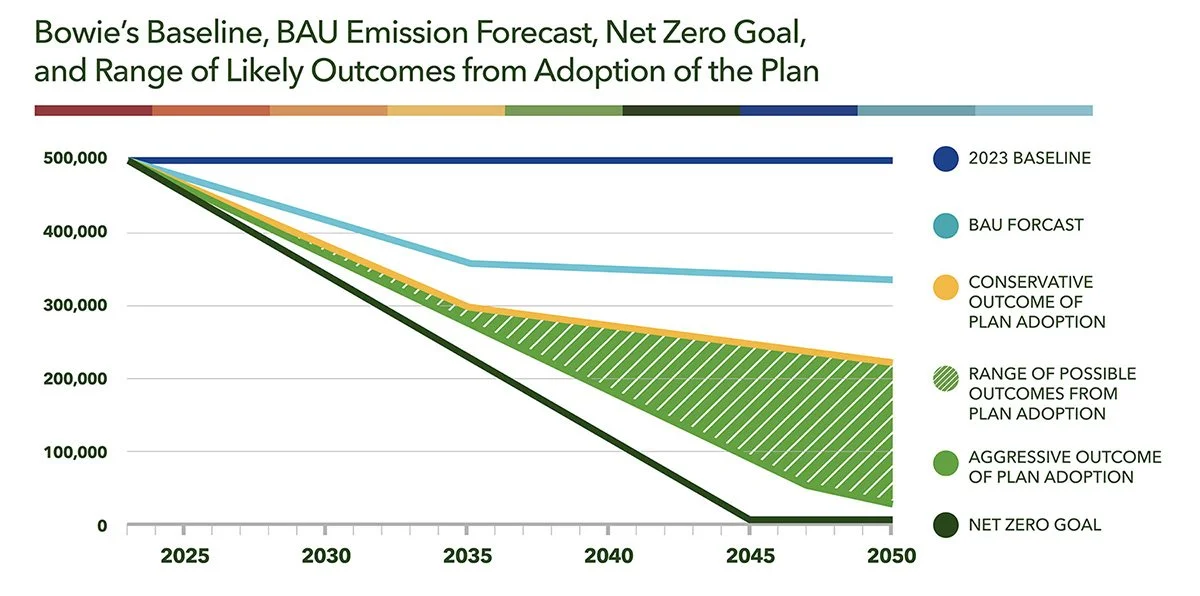
The City of Bowie set a goal of reaching net zero emissions by 2045 and wanted to understand how far the Plan’s recommendations would get them toward that target. The challenge is that many of the most impactful strategies, particularly those at the community level, depend on adoption rates that are inherently uncertain.
Rather than presenting a single forecast, we developed a range of possible outcomes. This range reflects both conservative assumptions about adoption and more aggressive, but still realistic, scenarios. For example, in modeling electric vehicle adoption, the conservative case assumes that current growth trends continue over time, while the more aggressive scenario reflects the full realization of policies such as Maryland’s Advanced Clean Cars II rule. The result is not a single prediction, but a bounded range that illustrates what progress could look like under different levels of participation.
What We Can (and Can’t) Forecast
Even with strong adoption across sectors, the analysis shows that the Plan does not fully close the gap to net zero by 2045 based on what can be reasonably forecast today. This is not unique to Bowie. Many jurisdictions face a similar reality.
Some components of future emissions reductions, such as grid decarbonization driven by Maryland’s renewable portfolio standard, can be incorporated with a relatively high degree of certainty. However, the remaining gap depends on factors that are more difficult to predict, including emerging technologies, future policy developments, and continued market evolution.
Importantly, this does not diminish the value of the Plan. Instead, it highlights what effective climate planning is meant to do: capture the reductions that can be achieved today, while creating a flexible framework that can incorporate new solutions as they emerge.
Moving Forward
At its core, local climate action is not about choosing between what is controllable and what is impactful, nor is it about waiting for perfect certainty. It is about aligning both- pairing leadership with scale, and acting decisively on what is known while preparing for what is still evolving.
That balance is where meaningful progress happens.