What the AI Data Center Boom Means for Local Governments

Over the past few years, municipal leaders have started hearing a new kind of pitch from developers: “We’d like to build a major AI data center here.” AI data centers are fundamentally different from the previous generation of data centers and warehouse projects. They use electricity around the clock at scales unheard of in most communities just a decade ago. At the same time, they often deliver a relatively small number of permanent jobs compared to other large energy consumers, such as factories or manufacturing campuses.
It’s an exciting moment, the chance for investment and participation in the growing AI economy, but it’s also one that raises practical questions about infrastructure, budgets, public services, and long-term community goals.
Energy Growth That Doesn’t Look Like Economic Growth
Historically, when energy use went up, local economic activity did too. More electricity typically meant more production, more jobs, and more goods. That correlation between energy use and GDP growth underpinned how governments forecast demand and allocate costs.
That assumption no longer holds. The rise of generative AI and hyperscale data centers has distorted that long-standing link. In fact, the surge in electricity demand driven by AI infrastructure is outpacing trends in gross domestic product. Energy use is going up faster than GDP growth in many cases, precisely because data centers are large power consumers, but they do not drive proportional local economic output.
Figure 1. Global electricity demand and GDP trends, 1995-2030
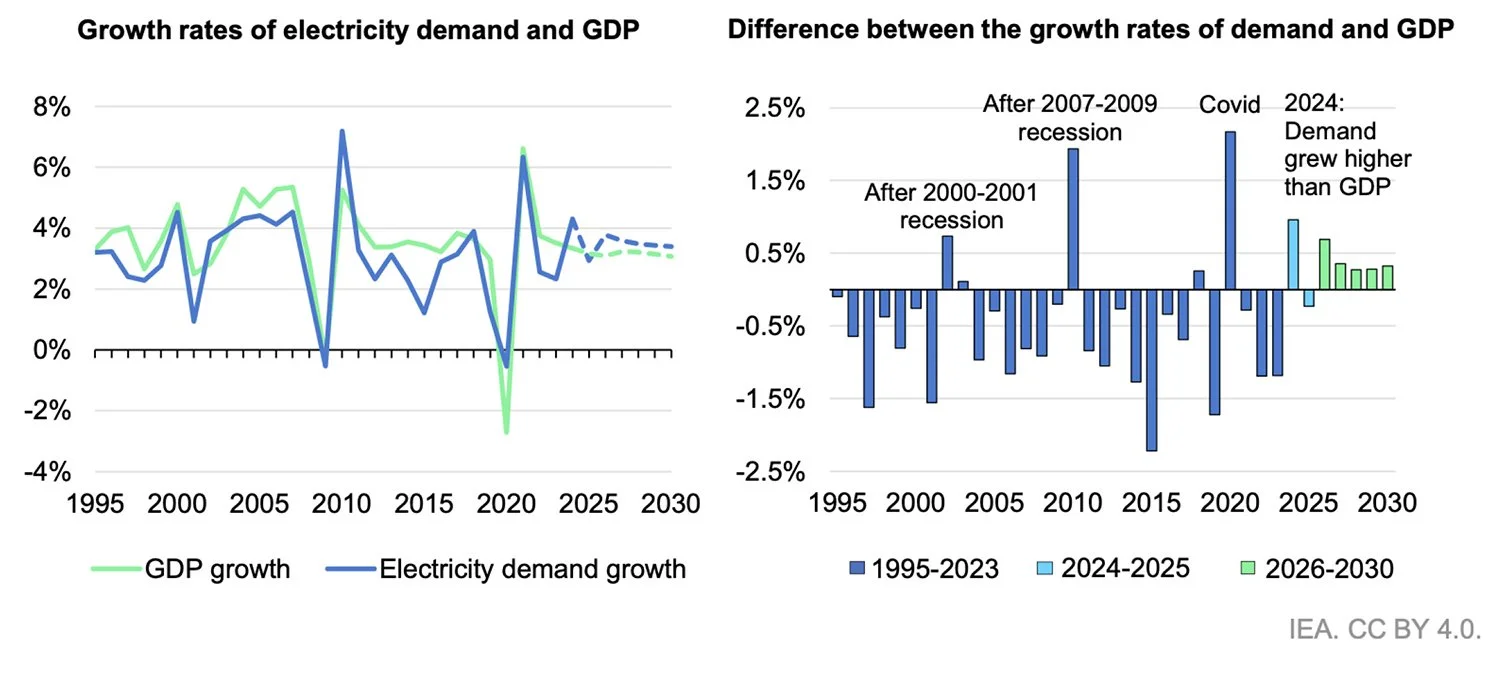
Note: Data for 2026-2030 are forecast values. GDP is based on the IMF World Economic Outlook.
Source: International Energy Agency (IEA), Electricity 2026
There are multiple reasons for this decoupling. In 2024, electricity demand grew significantly faster than the global economy for the first time in decades. This shift reflects a broader structural change partly due to increased electrification, warmer temperatures boosting air conditioning use, and expanding electricity-intensive industries. However, the rapid rise of AI data centers stands out as a major contributor to this accelerating demand growth.
Consider the jump from GPT-4 to GPT-5: training the new model required roughly ten times more computation, and thus significantly more power, even with efficiency gains. While GPT-5 represents meaningful technological progress, the resulting boost to economic productivity is measured in incremental percentage gains, not in the kind of ten-fold growth reflected in its energy demands. In the United States, data centers are projected to account for nearly half of the growth in electricity demand between now and 2030.
Figure 2. Projected power demand for data centers in the U.S.
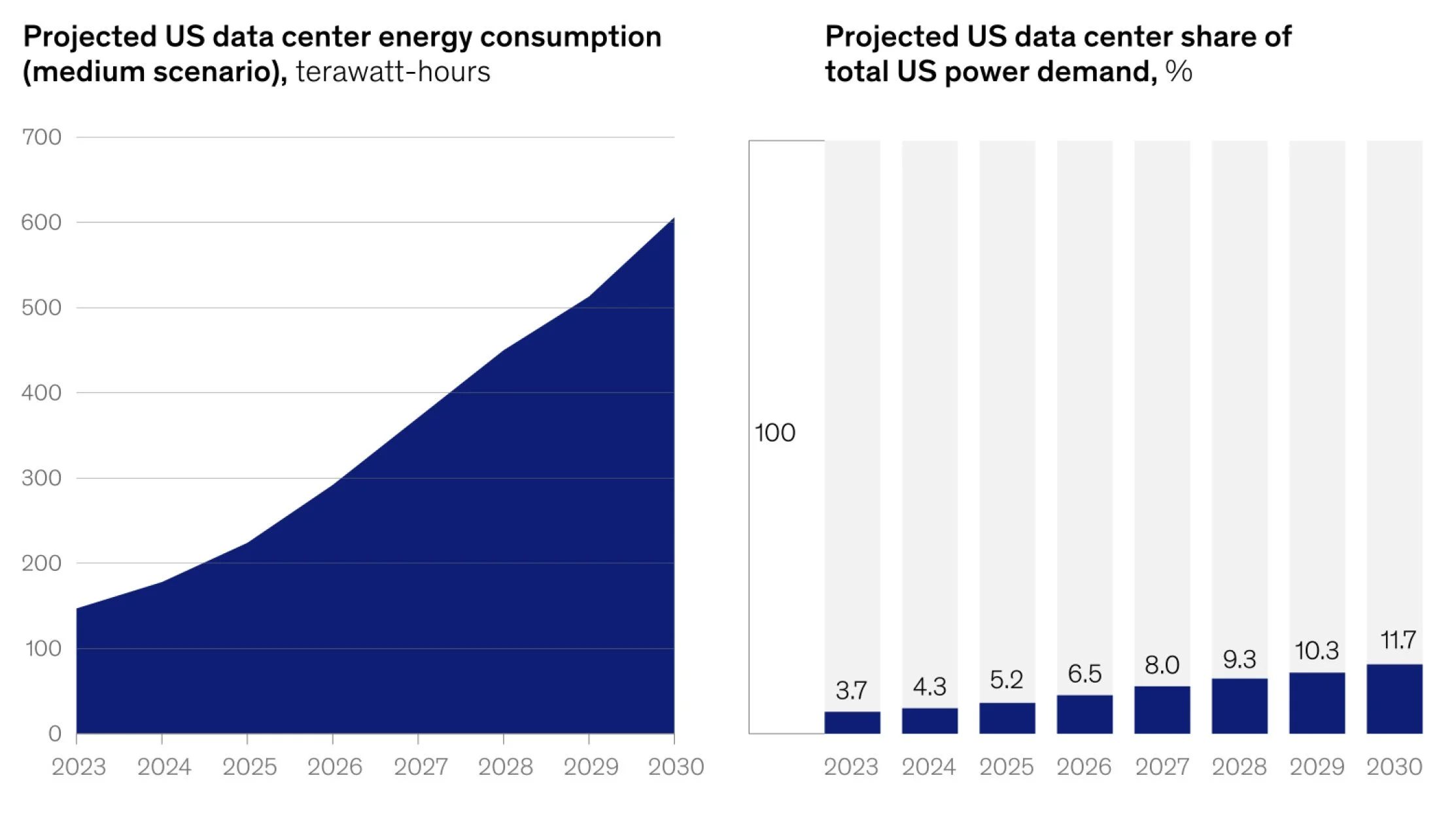
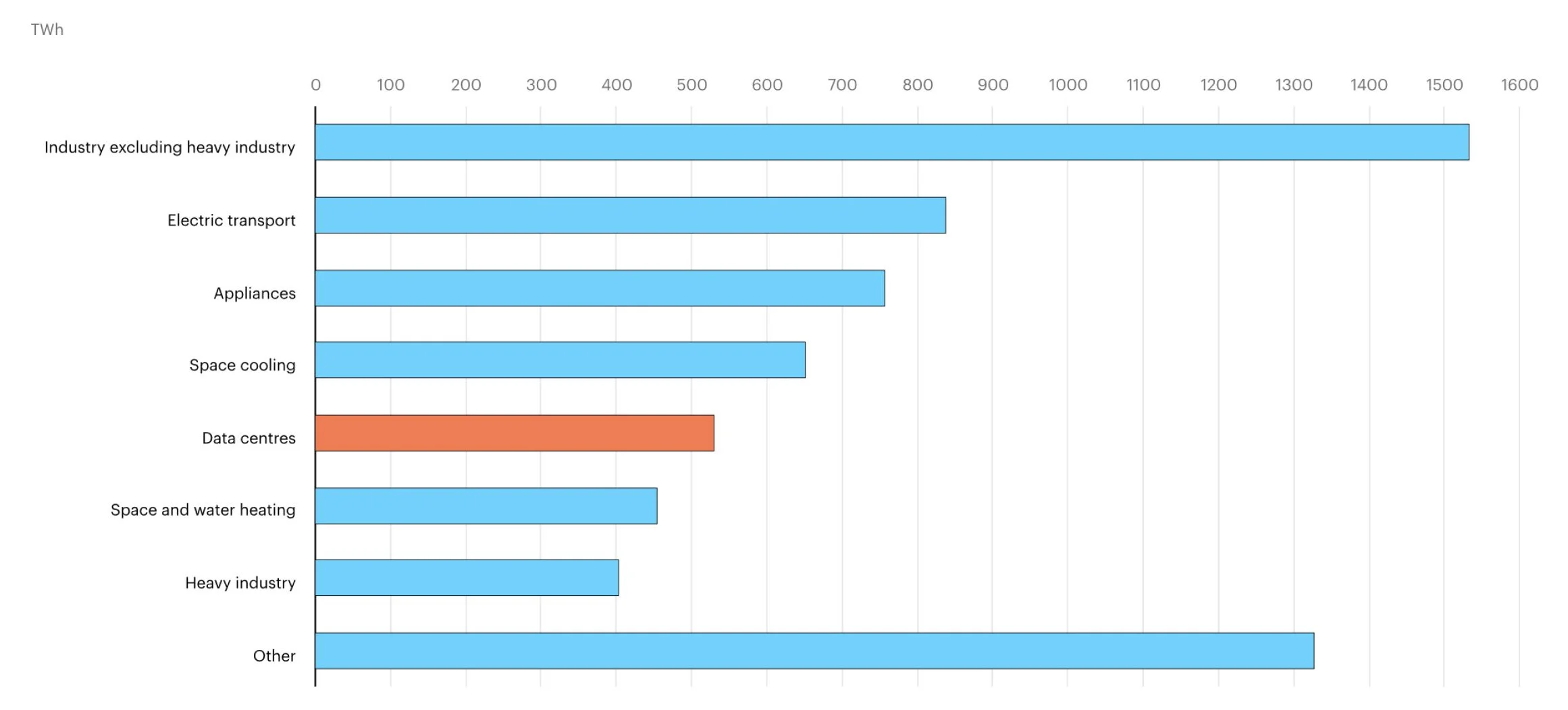
Although data center electricity use is rising quickly, on a global scale, it is expected to account for less than 10% of global electricity demand growth between 2024 and 2030. Most demand growth will still come from industrial expansion, electrification, electric vehicles, and increased air conditioning. However, unlike EVs, data centers are highly concentrated in specific areas, which can make their impact on local grids more intense and harder to manage.
Figure 3. Increase in electricity demand by sector, 2024-2030
The economic benefits of AI and data centers are less likely to be physically colocated with the data centers themselves. Energy-intensive facilities like factories usually bring a job base that employs substantial numbers of residents and powers the local economy. Data centers bring construction jobs, but once completed only require a skeleton crew to operate. Thus again, power consumption goes up dramatically, whereas there is only a slight increase in local economic activity.
Opportunity and Risk
From a municipal point of view, a data center is attractive on the surface: a big project, a new tax base, and a sign that a community is part of the technology economy. But many local leaders have begun asking deeper questions.
Utilities are critical partners in the development of modern AI data centers. There is no point to an unplugged data center after all. One of the first things municipal leaders hear when they engage utilities is: “We may need new substations, bigger transformers, and upgraded transmission to serve this load.” That infrastructure isn’t cheap, and if those costs aren’t carefully allocated, they can show up in higher rates for everyone.
There is growing attention nationally to how these costs get passed through to residents or commercial electricity consumers. In some states, utility regulators and legislators are debating whether data center developers should pay more upfront for projected load increases, because the traditional rate base model means that normal customers will have to pay a substantial amount of the bill. Changing laws around power-intensive development projects and their downstream rate consequences can help alleviate these unintended consequences for ratepayers. In fact, in Ohio, regulators approved a new tariff structure for AEP Ohio that aligns costs with large data center customers through long-term commitments and clearer cost allocation, protecting other ratepayers from infrastructure-related price spikes.
Energy isn’t the only resource these facilities touch. Many use water for cooling, sometimes substantial volumes, depending on design. Data center water demand can also spill into consequences for long-term drought planning and wastewater capacity.
Navigating the Tradeoffs and Solutions
There’s no universal answer to how every community should approach data center development, but there are ways to ensure that the decision is informed and aligned with broader community goals.
One idea gaining traction is to think creatively about partnerships that align infrastructure outcomes with community resilience goals. If a community is concerned about rising residential and commercial energy use, a data center developer might agree to invest in energy efficiency programs for residents or businesses. That could include incentives for home envelope upgrades, heat pump installations, or commercial building retrofits that reduce overall load on the grid.
Communities are experimenting with negotiating community benefit agreements (CBAs), setting expectations for workforce development, local procurement, and shared infrastructure investments. CBAs are increasingly necessary for large-scale data center projects to ensure that local residents see tangible benefits and that there are formalized expectations to provide accountability mechanisms. For example, in northern Indiana, as part of the agreement tied to Amazon’s $15 billion investment in new data centers, the company pledged to create 1,100 jobs, collaborate with local utilities on infrastructure upgrades, and expand STEM education opportunities for K–12 students in the community. Some communities are leveraging data centers for direct local benefits, capturing and reusing waste heat generated by AI data centers to support district heating and industrial processes. At the same time, in several regions, public backlash has stopped projects due to growing resistance in communities concerned about electricity price impacts, water use, and the limited number of permanent jobs associated with AI data centers.
An important reframing is to treat these projects like a “new industrial load” similar to how utilities and planners think about large manufacturing users or heavy industrial facilities, and integrate them into broader long-term infrastructure and land use planning so that ratepayers and residents are protected.
Thinking about how to best navigate the changing economic demands of the AI economy means asking tough questions: How will this affect our long-term electricity rates? How secure is our water supply if this becomes an operational user? And can we structure approvals so that community goals are met? Across the country, communities are demanding answers to these questions. Data centers can be part of a community’s future, but they need to be governed with thoughtful policy and clear expectations.