
Why Electrification Is Advancing With or Without You
Climate and energy debates have recently revolved around targets and commitments, but the global energy system is changing based on something more fundamental. Kingsmill Bond of RMI argues 'electrotech' is replacing 'fossil tech' due to physics, economics, and geopolitics, outperforming thermal combustion on basic system realities.(1) For local governments, this translates to immediate, practical benefits: electrified buildings are less exposed to fuel price volatility, electric fleets stabilize budgets, and distributed solar and storage increase resilience.
Consider Physics.
Today’s fossil fuel systems waste enormous amounts of energy. When coal, oil, or gas is burned, most of the energy is lost as heat before it ever delivers a useful service. Globally, roughly two thirds of primary energy never reaches end use. Transportation is the most extreme example, where internal combustion engines often convert less than a quarter of energy into motion.
Electrified systems operate very differently. Electric motors, heat pumps, and renewable generation dramatically reduce these losses, often delivering two to three times more useful energy per unit of input. This is why comparisons that show renewables as a small share of primary energy are misleading. Electrification does not need to replace the full fossil energy stack. It only needs to replace the portion that actually produces useful work. This insight alone shrinks the scale of the transition by a factor of three.
Within traditional systems, we lose about two thirds of the energy we produce.
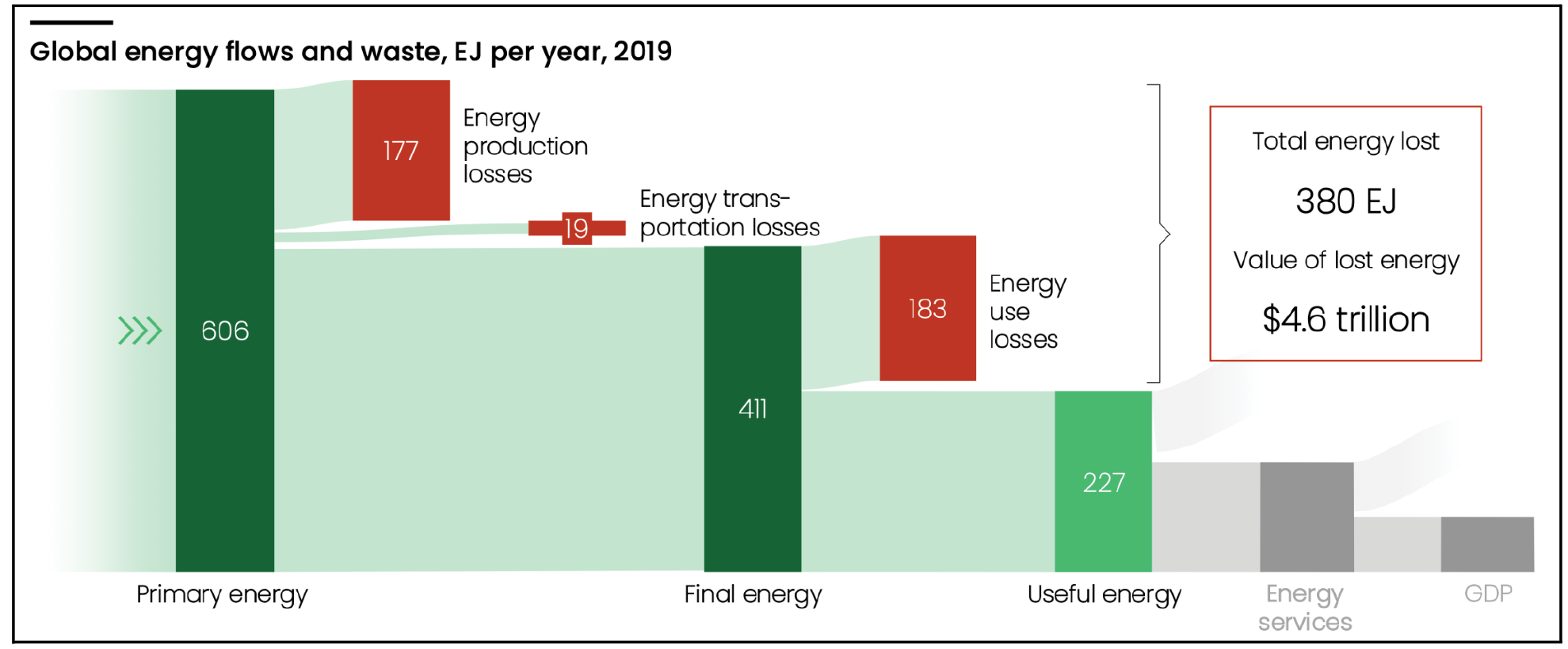
Source: RMI/Ember
Materials follow a similar logic. Fossil fuels require continuous extraction, transport, and combustion of billions of tons of material every year. Renewable and electrified systems require upfront construction of infrastructure, but after that energy flows for decades with little additional material input.
Economics reinforces these physical advantages.
Solar panels, batteries, and electric vehicles behave like technologies, not commodities. They are modular, mass manufactured, and improve as production scales. Learning curves show consistent cost declines as deployment doubles. Solar module prices have fallen from roughly $100 per watt in the 1970s to around ten cents per watt today. Battery pack costs have dropped by nearly 90 percent in the last decade. Fossil fuel extraction does not follow this pattern. As the easiest resources are depleted, extraction becomes more complex and expensive; innovation is required to offset depletion rather than to drive sustained cost declines.
Log scale chart showing price per unit versus cumulative deployment for solar PV and lithium ion batteries, 1075 - 2021
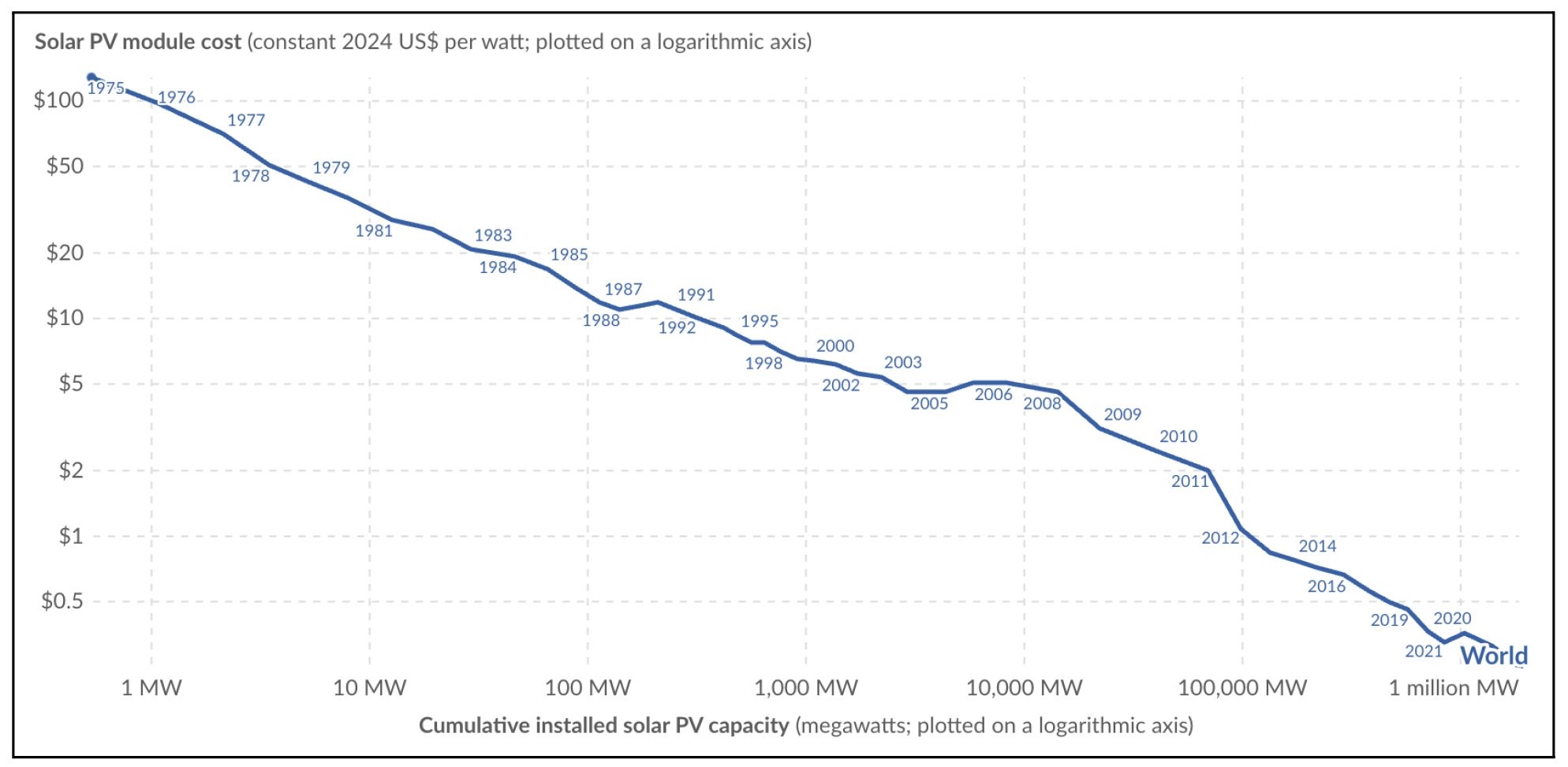
Source: Our World in Data, https://ourworldindata.org/grapher/solar-pv-prices-vs-cumulative-capacity
Once cost trajectories diverge, growth usually follows. Currently, new electricity demand is overwhelmingly met by solar and wind. Electrification is steadily absorbing growth in buildings, light industry, and road transport. The International Energy Agency’s own historical data shows fossil fuel demand has already peaked in several major sectors globally, including industrial energy and buildings, and is flattening in transport and electricity generation .
This matters because capital intensive industries behave very differently once growth stops. When demand peaks, investment shifts from expansion to extraction of remaining value. Assets consolidate, margins shrink, and decline accelerates.
Sector by sector fossil fuel demand peaks
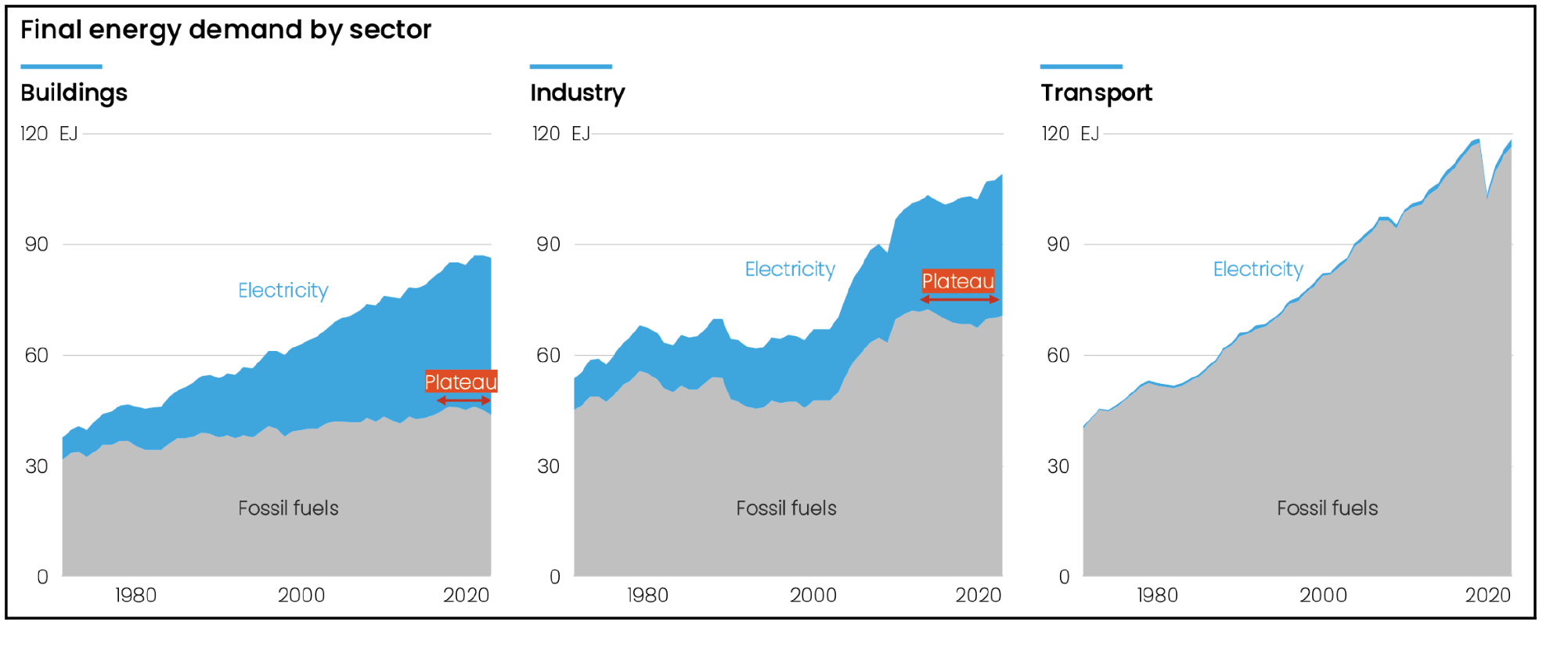
Source: IEA WEB; Ember analysis.
Geopolitics adds another layer, according to Bond.
Three-quarters of the global population lives in fossil fuel importing countries, making them strategically vulnerable. Electrification offers domestic energy security, shifting from "renting energy" (paying repeatedly for fuel that disappears when burned) to "owning assets" (long-lived solar, wind, and batteries that cannot be embargoed or repriced overnight).
Emerging markets illustrate this dynamic most clearly. Cheap solar, batteries, and electric vehicles are enabling leapfrogging past fossil fuel systems entirely. Electrification is accelerating not because of climate policy alignment, but because it is often the lowest cost option available. This trend directly challenges assumptions about long term demand for LNG and oil exports.
The energy transition is no longer waiting on consensus. It is being pulled forward by physics, economics, and security concerns that are difficult to reverse. The remaining question is whether planning, infrastructure, and investment decisions will align with the direction the system is already moving.
Electrification is not a future scenario. It is the present state of play.
(1) Ember Energy: https://ember-energy.org/latest-insights/global-electricity-review-2025/global-electricity-trends, and Volts Podcast, November 21, 2025.
